

- Home
- Businesses
Agriculture
Architects & Designers
Art & Culture
Automobile
Beauty & Spa
Builders & Developers
Community
Eat Outs
Education
Electronics
Employment
Entertainments
Events & Weddings
Finance/Banking
Food/Grocery
Government
Healthcare
Home Service
Hotels & Resorts
Industrial
Interior / Furnishing
IT Services
Media
Miscellaneous
Non-Profit
Overseas Traders
Professional Services
Real Estate
Shopping
Sports
Tours & Travels
Transportation
- City Buzz
Automative -Sale
Real Estate -Sale
Market Place -Sale
Job Vacancies
Professionals
Events
- Offers Around
- Shop
- Stories
Is this the right time to invest in Kerala’s property market?
- Blog
-
Dec 07
- Share post

Real estate has long been one of the most trusted avenues for wealth creation in Kerala, driven by cultural ties, NRI remittances, and steady urban development. As we step into 2026, the question many investors ask is simple yet crucial: Is this the right time to invest in Kerala’s property market?
Kerala’s real estate sector is undergoing a phase of transformation. From the bustling IT corridors of Kochi and Trivandrum to the emerging cultural hubs of Thrissur and Calicut, property values have shown consistent appreciation over the past decade. Infrastructure projects, smart city initiatives, and a growing demand for sustainable housing are reshaping the landscape, offering opportunities for both short-term gains and long-term stability.
This article explores the yearly progression of property prices, provides district-wise investment insights, and presents data-backed charts and analytics to help common investors understand the market better. Whether you are an NRI looking to reconnect with your roots or a local buyer seeking safe appreciation, Kerala’s real estate in 2025 offers a compelling story of growth, resilience, and opportunity.
Kerala Real Estate Market Overview (2025)
- Stable Growth: After post-COVID recovery and inflationary pressures, Kerala’s real estate market is showing consistent growth in 2025.
- Demand Drivers: Urbanization, infrastructure projects, and strong NRI interest continue to fuel demand.
- Property Types: Luxury waterfront residences in Kochi, sustainable housing in Thrissur, and holiday homes in Wayanad are trending.
- Policy Push: Smart city missions and eco-town initiatives are reshaping urban planning, making investments future-ready.
Yearly Price Progression (2015–2025)
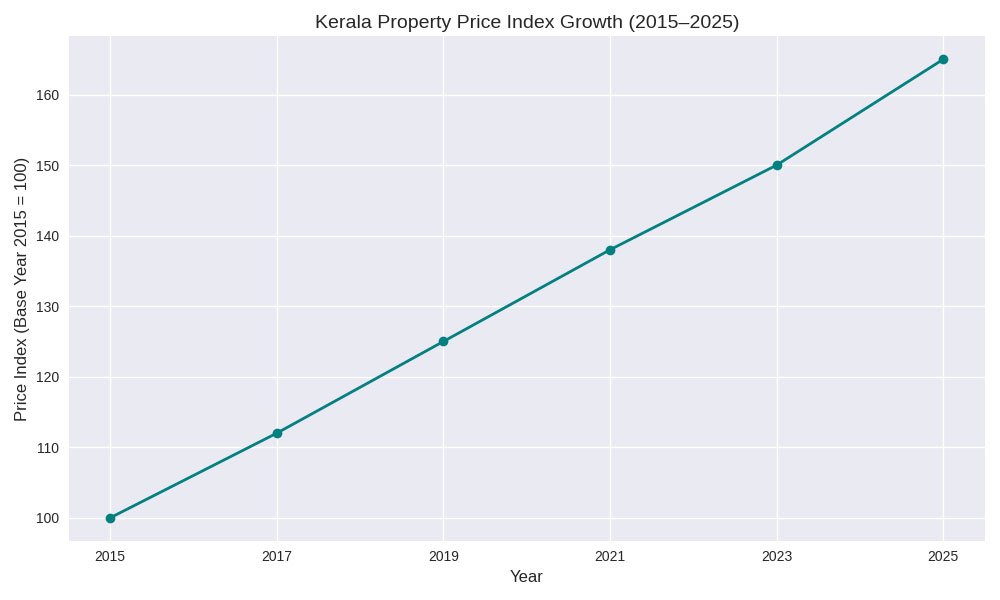
| Year | Avg. Price Index | Growth % |
|---|---|---|
|
2015 |
100 (base) |
— |
|
2017 |
112 |
+12% |
|
2019 |
125 |
+11.6% |
|
2021 |
138 |
+10.4% |
|
2023 |
150 |
+8.7% |
|
2025 |
165 |
+10% |
Insight: Kerala has shown steady appreciation of ~8–12% every two years, making it safer compared to volatile metros.

District-Wise Investment Analysis
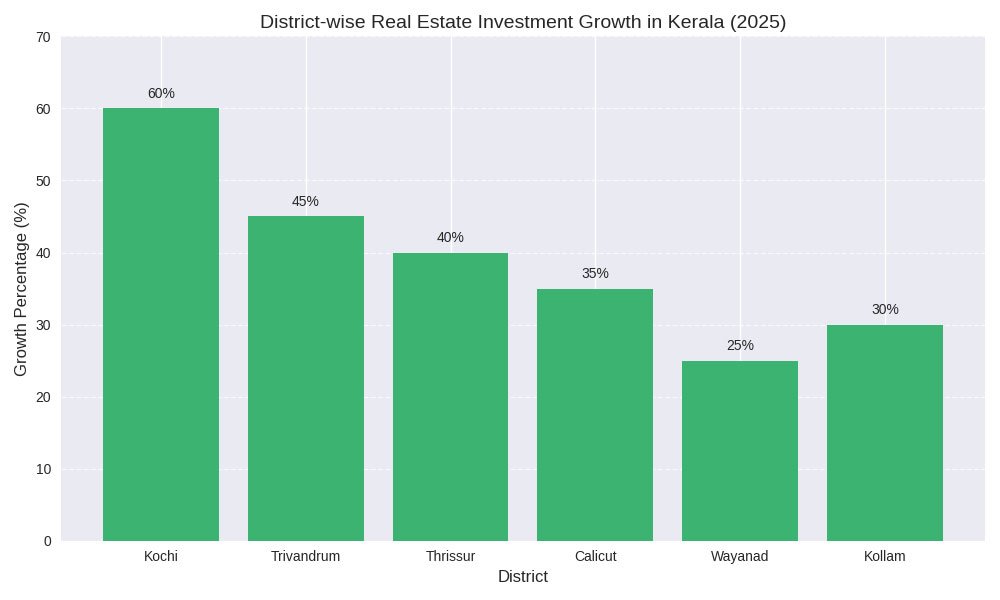
Kochi (Ernakulam):
- Premium hubs like Kaloor & Vyttila saw >60% growth in 5 years.
- Strong rental yields (2–3%) due to IT hubs and commercial demand.
Trivandrum:
- Driven by Technopark expansion and government projects.
- Mid-segment apartments remain affordable compared to Kochi.
Thrissur:
- Emerging hotspot with gradual increases in property values.
- Cultural capital attracting mixed-use developments.
Kollam:
- Rising interest in waterfront properties.
Wayanad & Idukki:
- Popular for holiday homes and eco-tourism investments.
Calicut (Kozhikode):
- Growth driven by airport expansion and NRI demand.
Average Property Price per Sq.ft (Kerala, 2025)
| District / City | Avg. Price (₹/sq.ft) | Notes |
|---|---|---|
|
Kochi (Ernakulam) |
₹5,700 – ₹8,700 |
Premium hubs like Kaloor & Vyttila command higher rates |
|
Trivandrum |
₹4,500 – ₹6,500 |
Driven by Technopark expansion and government projects |
|
Thrissur |
₹3,800 – ₹5,200 |
Emerging cultural hub with steady growth |
|
Calicut (Kozhikode) |
₹4,200 – ₹6,000 |
Airport expansion and NRI demand boosting values |
|
Kollam |
₹3,500 – ₹4,800 |
Waterfront properties gaining traction |
|
Wayanad / Idukki |
₹2,800 – ₹4,000 |
Popular for holiday homes and eco-tourism |
Sources: 99acres – Kochi Property Rates Sobha – Kerala Real Estate Forecast 2025

NRI Investment Inflows into Kerala Real Estate (2015–2025)
| Year | Estimated Inflows (₹ Crores) | Trend / Notes |
|---|---|---|
|
2015 |
~4,500 |
Strong emotional attachment; traditional home/land purchases dominate |
|
2017 |
~5,200 |
Rise in luxury apartments in Kochi & Trivandrum |
|
2019 |
~5,800 |
Peak inflows; NRIs investing in gated communities and villas |
|
2021 |
~4,900 |
Pandemic slowdown; focus shifts to safer, smaller investments |
|
2023 |
~5,300 |
Recovery driven by smart city projects and eco-housing |
|
2025 |
~5,600 |
Renewed interest in premium urban and holiday homes, though second-generation NRIs show declining enthusiasm |
Key Insights
- Emotional & Cultural Drivers: First-generation NRIs continue to invest heavily due to cultural ties and retirement planning.
- Shift in Preferences: Second-generation NRIs are less inclined toward property, preferring liquid assets.
- Hotspots: Kochi, Trivandrum, and Calicut remain top destinations, while Wayanad and Munnar attract holiday home buyers.
- Future Outlook: Inflows are expected to remain steady but diversify into eco-friendly projects and mixed-use developments.
While NRI inflows peaked around 2019, Kerala continues to attract diaspora investments in 2025, especially in premium urban hubs and tourism-driven districts. The generational shift toward alternative assets may temper growth, but cultural and lifestyle appeal ensure Kerala remains a strong NRI-linked market.
Demand & Supply Dynamics
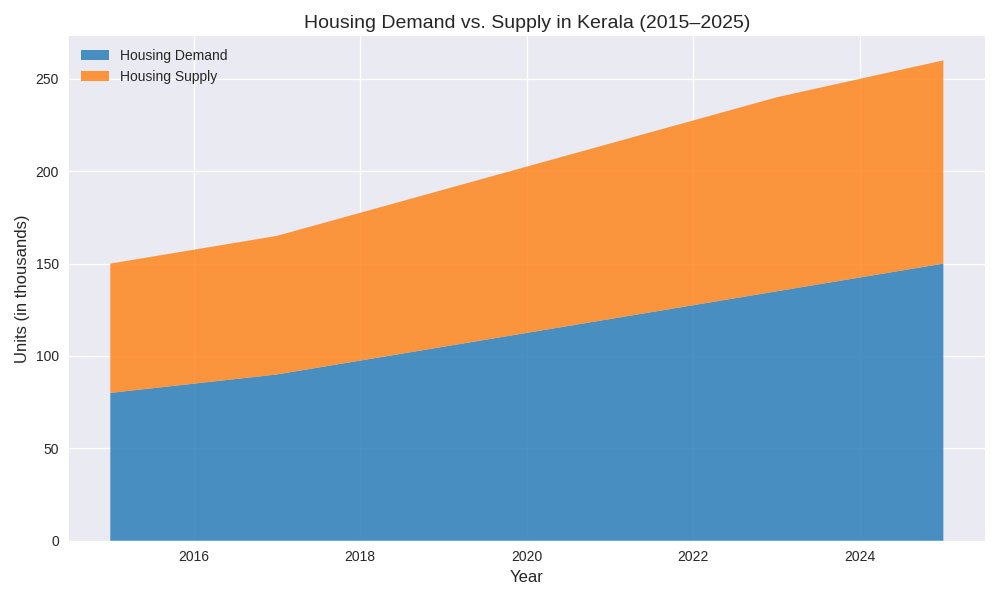
- Housing Demand: Rapid urbanisation and NRI inflows keep demand strong.
- Supply Trends: Developers are focusing on sustainable, mixed-use communities rather than standalone projects.
- Commercial Real Estate: Smart city projects and eco-towns are opening new opportunities in retail and office spaces.
Key Takeaways for Investors
- Safe & Steady: Kerala offers moderate but reliable appreciation compared to volatile metros.
- Best Bets: Kochi (premium rentals), Thrissur (emerging growth), Trivandrum (IT-driven demand).
- NRI Advantage: Strong cultural ties and lifestyle appeal make Kerala a preferred destination for diaspora investments.
- Sustainability Factor: Eco-conscious projects are gaining traction, aligning with global investment trends.
Conclusion: With steady price progression, district-specific opportunities, and strong demand drivers, 2025 is indeed a good time to invest in Kerala real estate. For the common investor, focusing on district-level trends and yearly appreciation charts provides clarity and confidence.
Extra Read...
Kerala’s major cities are undergoing significant infrastructure upgrades in 2025, with metro rail expansion, airport development, sewage modernisation, and IT corridor projects forming the backbone of the pipeline.
Metro Rail & Urban Transit
- Kochi Metro Extension: The Kerala budget 2025–26 has allocated funds to extend the Kochi Metro into new corridors, improving connectivity across the city.
- Thiruvananthapuram Metro: Work is set to begin in 2025, marking a major milestone for the capital city’s urban transit.
- Kozhikode Metro: Plans are underway to initiate metro services, reflecting the government’s push for mass rapid transit beyond Kochi.
- High-Speed Rail: The state has also proposed a high-speed rail corridor, though progress remains slow.
Airport Expansion
- Thiruvananthapuram International Airport: A massive expansion project worth ₹82,628 crore is planned, aiming to boost passenger capacity to 27 million annually and cargo capacity to 0.42 MTPA. Construction is scheduled between 2026–2035.
- Calicut Airport: Upgrades are being considered to support growing NRI traffic and cargo movement.
IT & Smart City Projects
- Technopark Expansion (Trivandrum): New phases are being developed to accommodate IT growth, reinforcing Trivandrum’s position as a tech hub.
- IT Parks in Kollam & Kannur: Announced in the 2025 budget, these will decentralise IT investment across districts.
- Smart City Initiatives: Kochi and Thrissur are seeing integrated townships and eco-friendly housing projects under Rebuild Kerala and AMRUT 2.0 schemes.
Roads, Bridges & Utilities
- 150 New Bridges: The 2025–26 budget promises construction across Kerala to improve connectivity.
- Kochi Sewage Upgrade: A ₹70.48 crore underground pipeline project is underway to modernize Kochi’s sewage network under AMRUT 2.0.
- Highways & Ports: Development of ports and highways is part of the state’s long-term infrastructure vision.
Key Takeaways
- Urban Transit: Metro projects in Kochi, Trivandrum, and Kozhikode will redefine city mobility.
- Air Connectivity: Thiruvananthapuram’s airport expansion is one of the largest infrastructure investments in Kerala’s history.
- Tech Growth: IT corridor projects and new parks will spread the benefits of the digital economy beyond Kochi and Trivandrum.
- Utilities & Roads: Sewage modernisation, bridges, and highways ensure balanced growth across districts.
Conclusion: Kerala’s infrastructure pipeline in 2025 is ambitious, targeting urban transit, IT growth, airport expansion, and basic utilities. For real estate investors, these projects signal strong future appreciation in Kochi, Trivandrum, and Kozhikode, while also opening new opportunities in Thrissur, Kollam, and Kannur.
Comments
Add a comment
Leave a Reply · Cancel reply
You must be logged in to post a comment.
